Rail Vehicle Test Data Acquisition Solution
Provides comprehensive test data acquisition solutions for rail transit vehicles including high-speed rail, metros, and urban rail. Covers bogie dynamics, braking performance, pantograph-catenary interaction, and cabin NVH. Supports distributed deployment with microsecond-level synchronization, meets EN 50155 rail standards, and operates reliably in extreme climates and high electromagnetic interference environments.
Learn moreRail Vehicle Test Data Acquisition Solution
Professional test and measurement solutions to accelerate industry digital transformation
Rail Vehicle Test Data Acquisition Solution
Provides comprehensive test data acquisition solutions for rail transit vehicles including high-speed rail, metros, and urban rail. Covers bogie dynamics, braking performance, pantograph-catenary interaction, and cabin NVH. Supports distributed deployment with microsecond-level synchronization, meets EN 50155 rail standards, and operates reliably in extreme climates and high electromagnetic interference environments.
5 Major Core Advantages
- Microsecond-level time synchronization:Supports GPS/BeiDou dual-mode time synchronization and IEEE 1588 PTP protocol, with multi-vehicle formation timestamp deviation under 1μs.
- Full-signal-type fusion acquisition:Unified access for multiple sensors—including strain, acceleration, pressure, temperature, voltage, and current—enabling multi-dimensional measurement within a single system.
- TEDS Smart Sensor Compatibility:Automatically detects TEDS sensor parameters, eliminating manual configuration to reduce human error and accelerate test setup.
- PoE single-network power supply:Simplifies Ethernet cabling by transmitting both data and power over a single cable, reducing installation complexity.
- SeeDeria Professional Software:Data analysis platform designed for rail transit testing, featuring built-in algorithms for dynamics analysis, fatigue assessment, and NVH evaluation.
4 core test scenarios
1. Vehicle Dynamics Testing
Perform dynamic performance testing on bogies, wheelsets, and suspension systems. Strain gauges measure frame stress, accelerometers monitor vibration response, and displacement sensors record suspension travel. The system supports a maximum sampling rate of 512kS/s, precisely capturing high-frequency transient events from wheel-rail interactions.
2. Structural fatigue testing
Perform fatigue life assessment on key structural components such as car bodies, bogies, and coupling devices. Continuously monitor stress cycle loads and predict remaining structural life using the rainflow counting method combined with Miner's cumulative damage theory. The device supports offline storage and remote data transmission to meet long-term monitoring requirements spanning several months.
3. Brake System Test
Record pressure changes, deceleration, and brake shoe temperature during braking to evaluate braking performance and safety margins. High-frequency sampling captures transient braking responses while synchronously recording data from multiple cars to analyze the uniformity of braking force distribution. Complies with UIC 544-1 braking system testing standards.
4. NVH Comfort Testing
Install microphones and accelerometers inside the cabin to evaluate passenger ride comfort. The system supports ISO 2631 human vibration exposure standards and automatically calculates comfort indices. With spectral analysis and order tracking, it identifies noise and vibration sources to guide isolation and noise reduction optimization.
Digital Vision for Railways
Build a digital testing system covering the entire vehicle lifecycle—from R&D validation and type testing to operations monitoring—to achieve data integration and knowledge accumulation. By leveraging edge computing and cloud platform collaboration, enable real-time fault diagnosis, predictive maintenance, and fleet management, driving intelligent transformation in rail transit.
Solution Overview
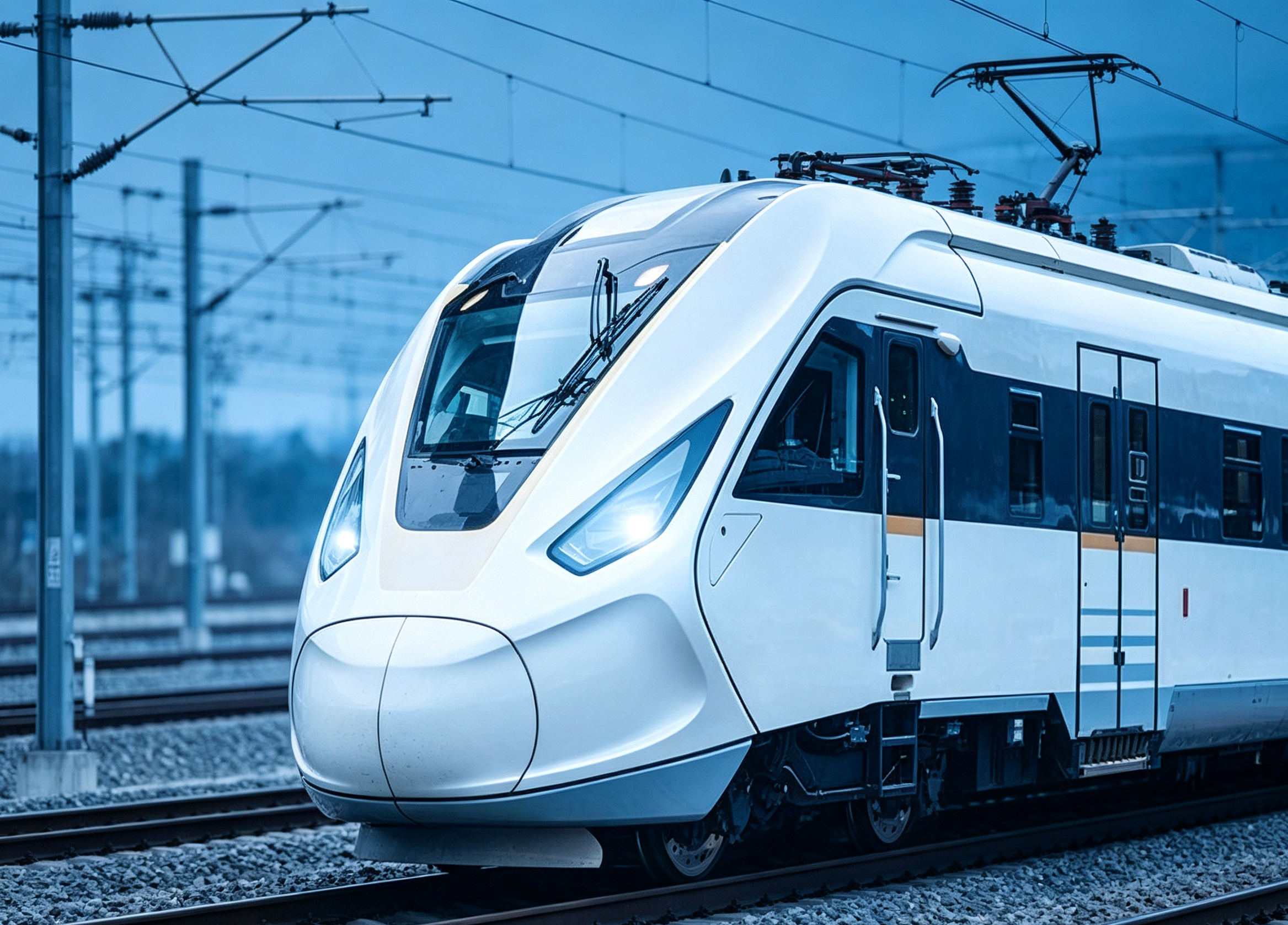
Provides comprehensive test data acquisition solutions for rail vehicles including high-speed, metro, and urban transit systems. Covers bogie dynamics, braking performance, pantograph-catenary interaction, and cabin NVH. Supports distributed deployment with microsecond-level synchronization to meet EN 50155 rail standards, ensuring reliable operation in extreme climates and high electromagnetic interference environments.
Use Cases
- •Dynamic Performance and Stability Testing of High-Speed Rail Bogies
- •NVH Comfort Assessment and Optimization for Subway Carriages
- •Online Monitoring of Pantograph-Catenary Contact Force and Current Collection Quality
- •Train Brake System Performance Validation and Safety Assessment
Industry Pain Points and Challenges
Gain deep insights into industry testing challenges and receive tailored solutions.
Rail transit vibration and noise monitoring points are widely dispersed, making cabling difficult.
Challenges in synchronized data collection for multi-vehicle platooning and the impact of timestamp discrepancies on analysis
High reliability requirements for equipment under extreme climate conditions (-40°C to +70°C)
Real-time fault diagnosis and rapid warning response
Low efficiency in storing and analyzing massive test data
Key Advantages
Advanced technology driving superior test and measurement experiences
Wireless sensor networks support long-range deployment, reducing wiring costs.
Microsecond-level time synchronization ensures data consistency across multi-vehicle formations.
IP68 rating withstands harsh outdoor environments and tunnel dust
Edge computing enables real-time anomaly detection and local alerts.
Cloud-based data management platform supports large-scale historical data analysis
Complies with EN 50155/IEC 61373 railway vibration and shock standards
Typical Use Cases
Covers core industry testing requirements to support the entire R&D and production lifecycle.
Dynamic Performance and Stability Testing of High-Speed Rail Bogies
NVH Comfort Assessment and Optimization for Subway Carriages
Online Monitoring of Pantograph-Catenary Contact Force and Current Collection Quality
Train Brake System Performance Validation and Safety Assessment
Online detection of track geometry parameters and line condition
Long-term structural health monitoring of bridges and tunnels
Technical Specifications
High-performance parameters for demanding test environments.
Customer Success Stories
Real-world success stories that help customers succeed
Bogie Dynamics Testing for a High-Speed Train Manufacturer
Major domestic high-speed rail vehicle manufacturers
The new Fuxing EMU bogies require comprehensive dynamic performance validation, with over 200 test points involving various sensors for strain, acceleration, and displacement. When operating in multi-car formations, all measurement points must be synchronized within 5 μs.
Deploy the FIDES-UNI6 distributed acquisition system with independent acquisition nodes per car, achieving microsecond-level synchronization via PTP. TEDS smart sensors auto-detect parameters to significantly reduce test setup time. SeeDeria software displays dynamic performance indicators in real-time and supports online evaluation.
Successfully completed the 300km/h speed-level dynamic test. All metrics meet TB/T 3546 standards, with the testing cycle reduced by 25% compared to previous trials.
Performance Verification of Braking System for Subway Rolling Stock
First-tier city subway operator
New subway trains require brake system type testing within limited operational windows. Rapid transient changes during braking cause key data loss due to insufficient sampling rates of conventional equipment.
Uses DM-M4-PRO collector with a sampling rate of 256kS/s to precisely capture the pressure rise and release process of the brake cylinder. PoE power supply simplifies in-cabin wiring, enabling installation and commissioning within 30 minutes.
All braking test items completed within the 4-hour maintenance window. Data quality certified by a third-party testing agency; train deployed on schedule.
Urban Rail Vehicle NVH Comfort Optimization Project
Intercity Rail Transit Equipment Manufacturer
Passengers have reported excessive noise in the cabin. We need to identify the primary noise source and implement corrective measures. Traditional acoustic testing equipment has limited channels, preventing simultaneous multi-point sound pressure level and vibration measurements.
Use the FIDES-ACC16 acceleration module with a high-precision microphone to set up 32 measurement points inside the car for synchronized data collection. SeeDeria software performs ISO 2631 comfort evaluation and uses transfer path analysis to identify major contributors.
HVAC units and floor vibrations were identified as the primary noise sources. Targeted improvements reduced in-cabin noise by 4dB(A)%, significantly boosting passenger satisfaction.
Long-term Structural Health Monitoring of Bridges for a Railway Bureau
Regional Railway Group Companies
Cross-river bridges exceeding 20 years of service require long-term structural health monitoring systems for safety assessment. Monitoring points are scattered across the deck, piers, and bearings, with cabling distances reaching several kilometers.
Deploy wireless sensor networks with a transmission range of up to 10 km, eliminating the need for long-distance cabling. Battery life exceeds 72 hours and can be paired with solar power for continuous monitoring. The cloud platform automatically alerts on abnormal deformation and stress overload.
Established a comprehensive bridge health monitoring system, collecting over 1TB of data and successfully issuing 2 alerts for abnormal bearing displacement to ensure safe traffic operations.
Need a custom solution?
Our technical experts will provide a tailored data collection solution based on your specific needs, offering full support from requirements analysis to system deployment.